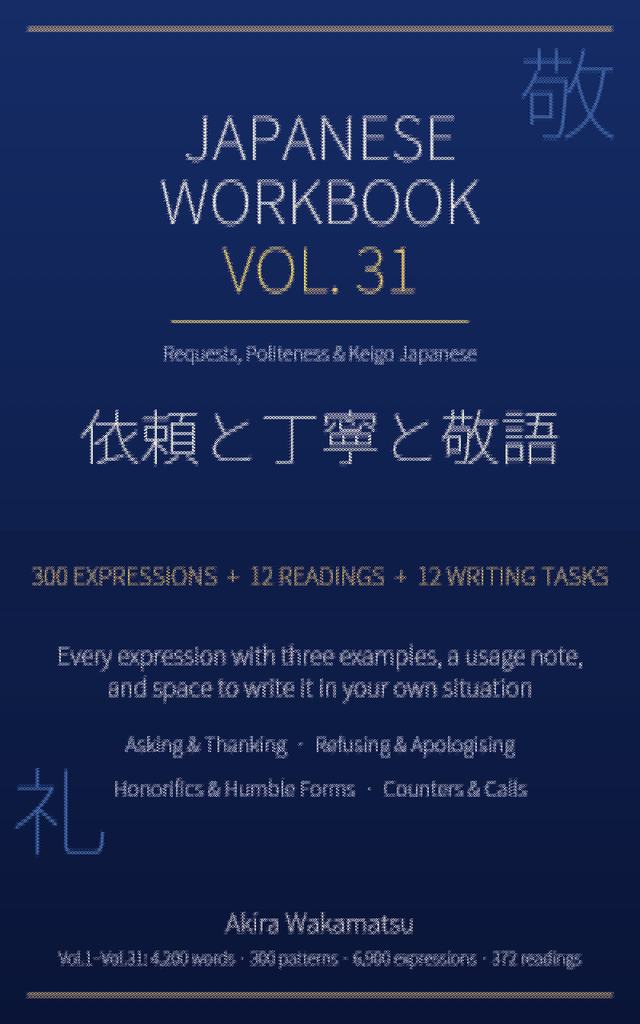
Japanese Workbook Vol.31
Requests, Politeness & Keigo Japanese
Series: Japanese Workbook · Vol. 31
- AuthorAki Wakamatsu
- PublisherTakikawa TOKOTOKO Kids LLC
- CategoryJapanese Workbooks
- FormatEPUB ebook
About this book
Japanese Workbook Vol.31: Requests, Politeness & Keigo Japanese — Ask Without Ordering, Refuse Without Wounding
A request that comes out as an order, a refusal that leaves the other person waiting, an apology that sounds like an excuse, thanks too small for what was done — these are the last walls even advanced learners of Japanese hit, because they are not grammar problems. They are problems of form: the shape a sentence takes when it asks, declines, apologises or thanks. This is the workbook that trains those shapes the way the series trains everything — by writing them, in your own situations, until they are ready before the moment arrives.
Part 1 — 300 practical expressions in 20 scene groups Asking: requests at home, at shops and restaurants, while travelling, at the office, and in letters and messages. Answering the ask: asking permission politely, offering help and volunteering, declining politely, apologising properly, and thanking and receiving with grace. The honorific system itself: respectful words for seeing, hearing and knowing, respectful words for speaking, coming and going, humble words for saying and doing, humble words for visiting, receiving and borrowing, and beautiful words and honorific nouns. Politeness in practice: cushion words and softening phrases, the counter at the clinic, bank and city hall, polite Japanese on the telephone, visiting and receiving guests, and choosing the right level of politeness. Every expression includes its reading, romaji, English meaning, a usage note (the scene, the distance to the other person, the care to take), three example sentences in Japanese and English, and a ruled practice space for three sentences of your own.
Part 2 — 12 writing tasks in three stages Short notes daily politeness runs on (a note asking the family for something, asking the staff in a shop, a short note of apology, writing thanks to someone who helped), messages that handle a situation (asking permission for a day off, declining an invitation politely, asking on the telephone for someone, asking for an appointment to visit), and full written pieces (a formal letter of request, reporting a failure with an apology, welcoming and guiding a guest, writing with the levels of politeness chosen well) — each with a model answer that really uses this volume's expressions, a self-check list and a full writing grid.
Part 3 — 12 readings in the genres of politeness's documents A guide to writing a polite letter of request, an explanation of how respectful and humble words work, a guide to declining politely when the time is wrong, an explanation of how to apologise and what to hold in the heart, a guide to asking properly at shops and inns, a guide to the honorifics of the telephone, a guide to words that give no offence when visiting, an explanation of how to speak when consulting someone above you, a guide to choosing the words of gratitude, an explanation of how to ask permission, a guide to using the degrees of politeness, and a guide to the greetings at the beginning and end of a letter — each with a full translation, five key words and three comprehension questions.
Series integrity: zero overlap, no exceptions All 300 expressions and all 12 reading titles were checked item by item against everything in Vol.1–Vol.30 (11,100 headwords and 360 reading titles): overlap zero. Across the thirty-one volumes you now train 4,200 words, 300 sentence patterns, 6,900 practical expressions and 372 readings. One honest note: the level of politeness that fits differs with the scene, the relationship and the size of what is asked, and where people differ this book teaches you to choose rather than assuming one level fits all. It is a language workbook, not a book of etiquette law and not a business manual: it teaches the living forms, and it promises no promotion, no pardon and no granted request.
For learners who have finished Vol.1–Vol.30 or who already read and write Japanese at an advanced level — and above all for anyone who works or lives in Japan and wants their asking, refusing, apologising and thanking to land the way they meant it.