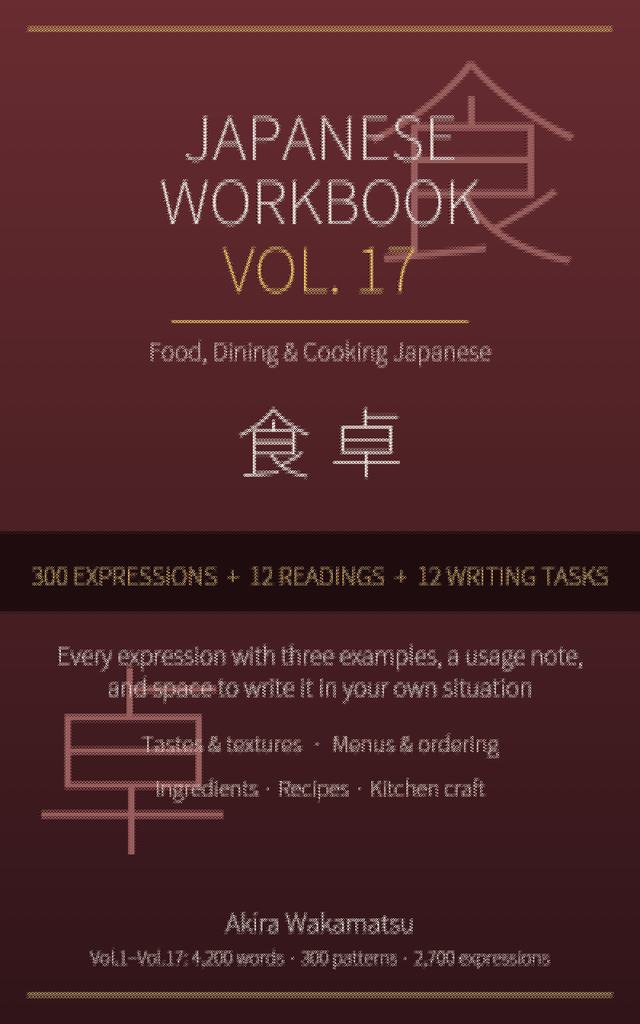
Japanese Workbook Vol.17
Food, Dining & Cooking Japanese
Series: Japanese Workbook · Vol. 17
- AuthorAki Wakamatsu
- PublisherTakikawa TOKOTOKO Kids LLC
- CategoryJapanese Workbooks
- ISBN1990000158131
- FormatEPUB ebook
About this book
YOUR JAPANESE WORKS ON PAPER, ON SCREEN, ON THE ROAD, IN THE CLINIC, AT THE SHOP COUNTER, AT YOUR DESK, IN THE CLASSROOM AND AT HOME. NOW MAKE IT WORK AT THE TABLE AND IN THE KITCHEN: 300 EXPRESSIONS FOR TASTE, MENUS, ORDERING, INGREDIENTS AND RECIPES, 12 FOOD AND DINING DOCUMENTS, 12 WRITING TASKS.
Finished Vol.1 through Vol.16? Your Japanese handles daily life, devices, journeys, health, money, work, school and home. But eating is where it is used three times a day: the soup whose umami you want to name, the menu whose characters you cannot yet read, the heat you must ask them to hold back, the ingredient you cannot eat and must explain without offence, the market fish whose freshness you must judge, the recipe whose measures you must convert. This is the volume that teaches the expressions eating in Japan runs on, and makes you write with them.
Inside: 300 practical expressions in 20 groups organised by scene — before the meal: table manners and starting, tastes: flavours and seasoning balance, texture, temperature and freshness, hunger, appetite, likes and dietary needs, vegetables, fruit and seasonal ingredients, fish, meat, eggs and soy foods, seasonings, sauces and pantry staples, reading a menu and dish names, ordering food and drink at a restaurant, customising a dish: portions, heat and substitutions, sushi, sashimi and rice dishes, noodles: ramen, soba and udon, grilled, fried and hot-pot dishes, breakfast, set meals and bento boxes, cafes, sweets, tea and coffee, izakaya and sharing food with friends, in the kitchen: preparation and tools, cooking methods: heat, timing and doneness, recipes, measures and instructions, and after the meal: thanks, compliments and invitations. Every expression comes with its reading, romaji, meaning, a short usage note — the scene, the person it suits, the level of politeness, the trap to avoid — three natural example sentences in Japanese and English, and a practice space for three sentences of your own: your tastes, your table, your kitchen.
Plus 12 graded writing tasks in three stages — short messages, messages that handle a situation, then full pieces (a reservation note, a note about foods I cannot eat, a note giving impressions of a dish, a shopping list note for ingredients, inviting a friend to a meal, an application to join a cooking class, teaching a recipe to a friend, a thank-you letter for a dinner gathering, my favourite dish, a report on a local dish, a dish I can never forget, a letter to the person who cooks for me) — each with a model answer that really uses this volume's expressions, a self-check list and a full writing grid. And 12 readings of real food and dining documents: a restaurant menu and ordering guide, a seasonal vegetables and fruit guide, a sushi shop ordering and manners guide, a noodle shop ticket guide, an izakaya sharing and settling-up guide, a cooking class guide, a food labels and dates guide, a morning market guide, a sweet shop tea and sweets guide, a hot pot guide, a local dishes guide, and a dinner invitation letter. Every reading in real Japanese, with a full English translation, key words and questions.
26,500+ guided practice squares. Review quizzes close every group, with a full answer key and an expression index at the back. A 12-week study plan in the front matter (25 expressions, one writing task and one reading a week) takes you through the whole book. All 300 expressions and all 12 readings are entirely new — zero overlap, no exceptions, against Vol.1–Vol.16: after this volume the series totals 4,200 words, 300 patterns, 2,700 expressions and 204 readings. An honest note: this book teaches the language of food, dining and cooking, not nutrition, medical or food-safety advice — the sentences for describing, asking and adjusting, with tastes and house rules left to confirm with the shop and the household in front of you.
Inside: 300 expressions with usage notes and example sentences · 12 graded writing tasks with models and checklists · 12 readings of food and dining documents · quizzes and answer key · 12-week plan.
Made in Japan: this workbook was written by Japanese author Aki Wakamatsu and produced and published in Japan by Takikawa TOKOTOKO Kids LLC — a Japan-made workbook, written from inside the tables and kitchens it teaches.
Written and created in Japan by Japanese author Aki Wakamatsu. Published by Takikawa TOKOTOKO Kids LLC, a Japanese publisher in Hokkaido, Japan. Authentic Japanese content, carefully made in Japan — not mass-produced.