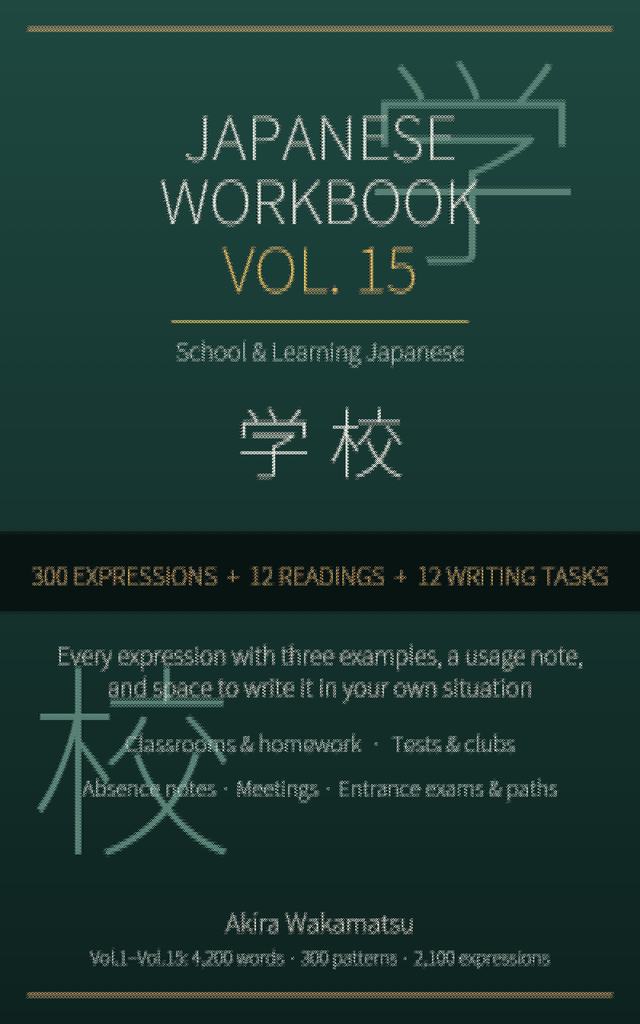
Japanese Workbook Vol.15
School & Learning Japanese
Series: Japanese Workbook · Vol. 15
- AuthorAki Wakamatsu
- PublisherTakikawa TOKOTOKO Kids LLC
- CategoryJapanese Workbooks
- FormatEPUB ebook
About this book
> YOUR JAPANESE WORKS ON PAPER, ON SCREEN, ON THE ROAD, IN THE CLINIC, AT THE SHOP COUNTER AND AT YOUR DESK. NOW MAKE IT WORK WHERE YOU LEARN: 300 EXPRESSIONS FOR CLASSROOMS, HOMEWORK, TESTS, CLUBS AND SCHOOL OFFICES, 12 SCHOOL DOCUMENTS, 12 WRITING TASKS. > > Finished Vol.1 through Vol.14? Your Japanese handles daily life, devices, journeys, health, money and work. But school is where it is used every single day, by students and by the parents who stand behind them: the letter from the school you must read correctly, the absence you must report by eight in the morning, the instruction you must catch the first time, the homework deadline you must not miss, the question you must ask the teacher, the meeting where you must hear how your child is really doing, the future path you must state with its reasons. This is the volume that teaches the expressions school life in Japan runs on, and makes you write with them. > > Inside: 300 practical expressions in 20 groups organised by scene — choosing a school and school types, enrollment, transfer and procedures, the school year and its events, the school day and timetable, lessons in the classroom, classroom language and instructions, asking teachers and consulting, homework and handing in work, tests, marks and results, friends and classmates, school lunch and breaks, clubs and after school, absence, lateness and leaving early, the nurse's office and school health, parents, guardians and the school, cram school and lessons, the library and self-study, entrance exams and future paths, ceremonies and assemblies, and school rules, safety and belongings. Every expression comes with its reading, romaji, meaning, a short usage note — the scene, the person it suits, the level of politeness, the trap to avoid — three natural example sentences in Japanese and English, and a practice space for three sentences of your own: your school, your class, your next lesson. > > Plus 12 graded writing tasks in three stages — short messages, messages that handle a situation, then full pieces (an absence note, a question memo for the teacher, a belongings check memo, a school lunch duty record, a transfer student's self-introduction, applying to visit a club, impressions and thanks after class visit day, the reasons for your future path hopes, looking back over a term of learning, a report on a school event, a composition on your future dream, a thank-you letter to a graduating senior) — each with a model answer that really uses this volume's expressions, a self-check list and a full writing grid. And 12 readings of real school documents: an admission guide, the year's events guide, a timetable and belongings notice, a school lunch menu and food survey guide, a class visit day and meeting notice, a guide to reporting absence, lateness and early leaving, a club joining guide, library news and borrowing rules, a future-path survey and meetings guide, a school trip guidebook message, a guide to the scope of the regular tests and how to study, and a guide to the graduation and closing ceremonies. Every reading in real Japanese, with a full English translation, key words and questions. > > 26,500+ guided practice squares. Review quizzes close every group, with a full answer key and an expression index at the back. A 12-week study plan in the front matter (25 expressions, one writing task and one reading a week) takes you through the whole book. All 300 expressions and all 12 readings are entirely new — zero overlap, no exceptions, against Vol.1–Vol.14: after this volume the series totals 4,200 words, 300 patterns, 2,100 expressions and 180 readings. An honest note: this book teaches the language of school and learning, not exam coaching or career advice — the sentences for asking, reporting and checking, with rules and systems left to confirm with the school in front of you. > > Inside: 300 expressions with usage notes and example sentences · 12 graded writing tasks with models and checklists · 12 readings of school documents · quizzes and answer key · 12-week plan. > > Made in Japan: this workbook was written by Japanese author Aki Wakamatsu and produced and published in Japan by Takikawa TOKOTOKO Kids LLC — a Japan-made workbook, written from inside the classrooms it teaches.