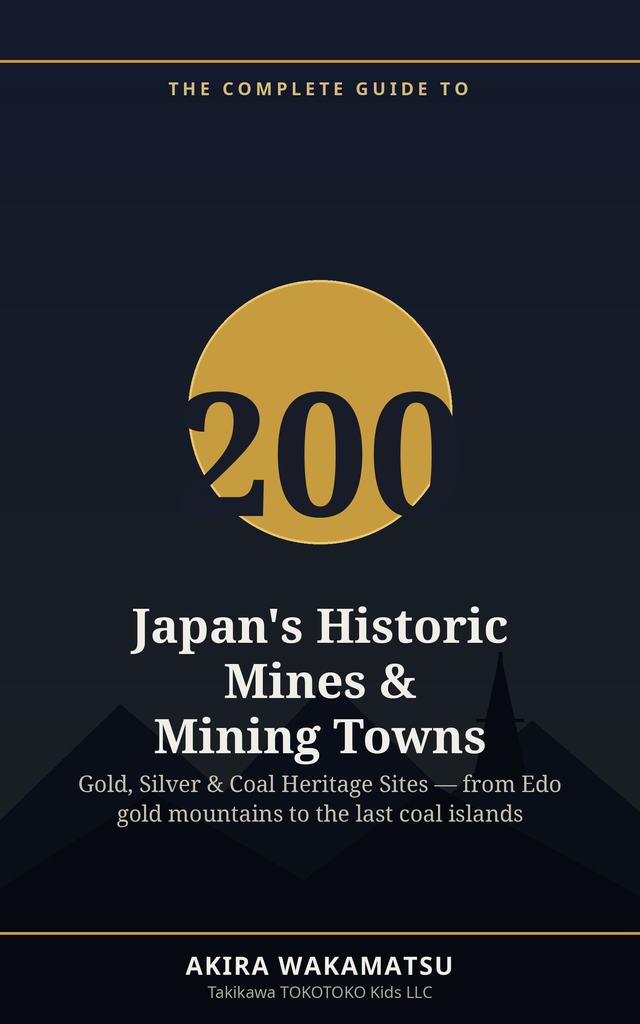
Japan's Historic Mines & Mining Towns
The Complete Guide to 200 Gold, Silver & Coal Heritage Sites
- AuthorAki Wakamatsu
- PublisherTakikawa TOKOTOKO Kids LLC
- CategoryJapan Guides & Culture
- ISBN1990000146152
- FormatEPUB ebook
About this book
Written and produced in Japan by Aki Wakamatsu. Japan is usually described through what grows on it and what is built on it — but for most of its recorded history the country was also dug. Gold from Sado paid for the Tokugawa order; silver from Iwami reached the markets of Manila and Amsterdam; copper from Ashio and Besshi wired the Meiji state; coal from Miike and Chikuhō fired its boilers; and iron sand from the Chūgoku mountains had already been becoming sword steel for a thousand years before that. This complete guide covers all 200 sites of that dug Japan in one uniform format — The Site / History & Industry / The Heritage Today / Visiting & Checking — across five parts: gold and silver (Sado, Iwami, Hishikari), copper (Ashio, Besshi, Kosaka and the smelter islands), coal (Miike, Chikuhō, the undersea island collieries of Nagasaki, Jōban, and Hokkaido's Sorachi company cities), iron and the working metals (tatara furnaces, Kamaishi, Yahata, zinc, lead, sulphur, mercury), and stone, clay and fire (limestone mountains, quarries, ceramic earths, and Japan's modest oil and gas fields). The book never asserts that a site is open or accessible: every entry ends with an official-check instruction naming its own city, town, museum or operator. The industry's costs — the Ashio pollution disaster, the Jinzu River cadmium poisoning, coerced wartime labour, and the dead of the accidents — are recorded in their entries as fact, without sensationalism. Honest count: the 200 are mines, mining towns, smelters, refineries, quarries, oil fields and the transport and settlements that served them; sites that are history rather than visitable destinations (the lost Karafuto coalfields above all) are labelled as such in their entries. Text-only edition by design: it teaches the reader to read headgear, terraces, slag and street plans instead of photographs.